How Students Can Record an Evidence-Based Scientific Model Revision
Students should preserve their original model, identify the new evidence, change the specific component or relationship that evidence bears on, and save a revised version. Add a revision note linking the original idea, the evidence, the change, and the scientific reasoning. The result should show both what changed in the model and why.
Save the original, then make the evidence-linked change
Students can revise a scientific model by saving the original version, identifying the new evidence, and changing a specific component, relationship, or assumption. They should then record why that evidence supports the change. Keep both versions visible so a reader can trace the revision.
For New York science teachers in grades 8–12, a useful student submission contains three things: Model V1, Model V2 with the change marked, and a short evidence-linked revision note. A drawing, equation, or other representation needs an explanation of its symbols and relationships wherever their meaning would otherwise be unclear.
NGSS Appendix F describes evidence-based model revision in both the middle-school and high-school progressions. It supports the underlying practice; the recording routine below is an editorial synthesis for classroom use, rather than an official Regents scoring rubric or a tested intervention. [NGSS Appendix F, Practice 2](https://www.nextgenscience.org/sites/default/files/resource/files/Appendix%20F%20%20Science%20and%20Engineering%20Practices%20in%20the%20NGSS%20-%20FINAL%20060513.pdf)
Begin this routine after students have identified a reason to revise. If they still need to decide whether a prediction agrees with observations, use the separate [model-and-evidence comparison routine](/blog/scientific-model-predictions-evidence-routine).
Preserve what the first version actually said
Before students erase or redraw anything, have them label the original “V1” and save it. A photograph, copy, or second sheet is sufficient. Record the phenomenon or question the model addresses and the conditions it represents.
Ask students to identify the particular idea they are reconsidering: “In V1, this arrow means ___,” or “My original equation assumes ___.” If an idea was unstated, add a note identifying it as a clarification of the original thinking. Preserve that distinction rather than silently inserting it into V1.
Separate model versions from stages of a phenomenon. A model may already show a system before and after an event. V1 and V2 are versions of the explanation, and each may need to represent both stages. Otherwise, students can accidentally submit two pictures of an event without showing any change in their scientific thinking.
Attach evidence to the exact feature being revised
Give each relevant evidence item a short identifier, such as E1. Beside it, record what was observed or measured and where the information came from: a table row, demonstration record, image, or reading passage. Include values, units, and conditions when they are part of the available record.
Then ask: “Which part of V1 does E1 give us a reason to change?” Students should point to a component, arrow, boundary, parameter, or written assumption. “The experiment changed my mind” leaves the connection unspecified.
Choose the revision by the idea that needs changing. Add a component when the explanation omitted something relevant. Remove a feature when its inclusion is unsupported. Change an arrow when the direction or meaning of an interaction changes. Change a parameter or equation when the represented quantitative relationship changes.
These are suggested revision choices, not requirements to make every kind of change. Keep features students still have reason to retain. If the evidence does not establish a proposed mechanism, mark that mechanism as tentative or record it as an unanswered question.
Example: revise how a model accounts for air’s mass
Consider this invented student-work example based on a classroom demonstration described by the American Chemical Society. The model versions and revision note are editorial illustrations, not collected student responses, an experimental record, or NYSSLS product output.
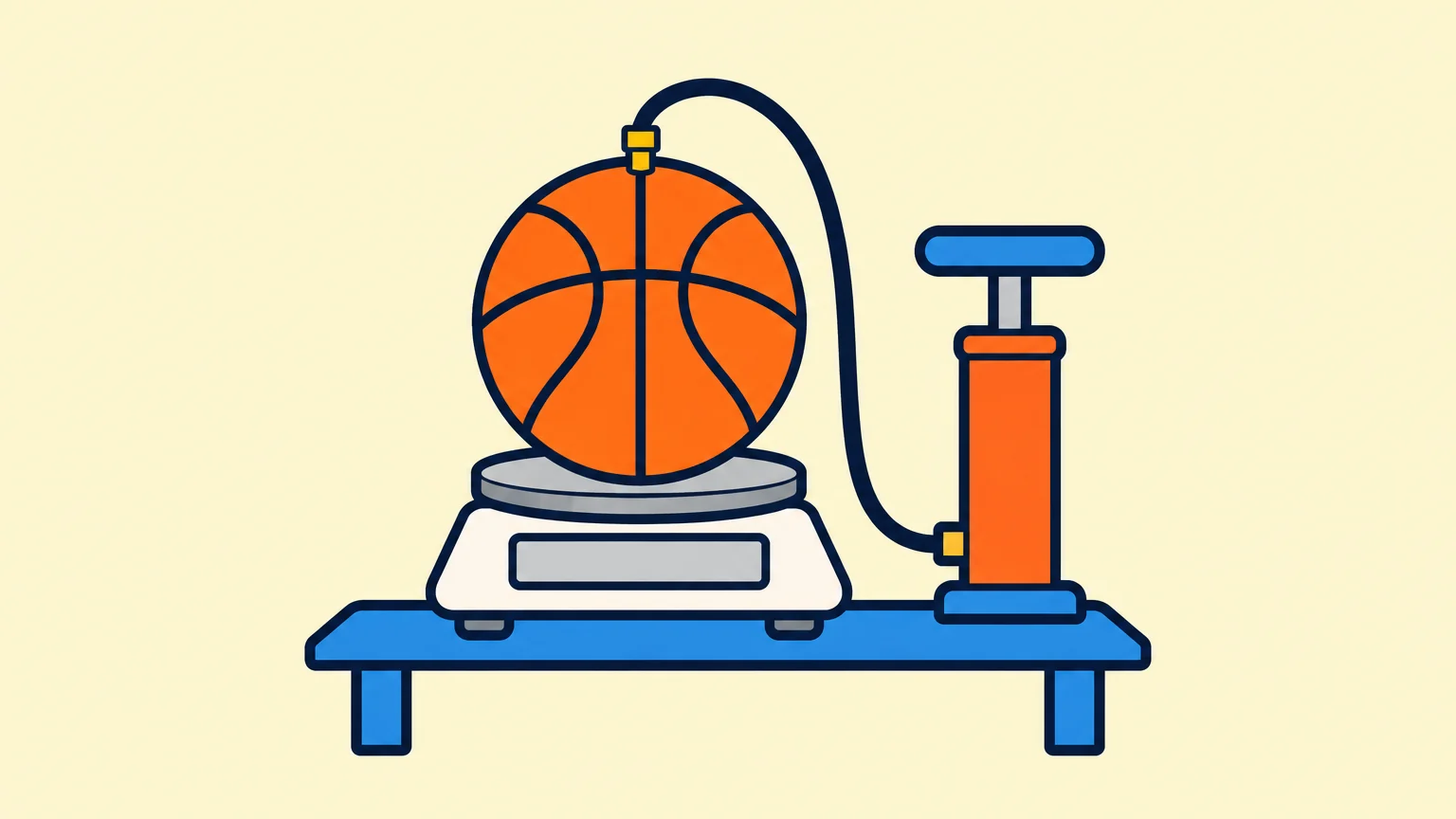
Question: How does adding air affect the mass of a basketball and its contents? Model V1 shows the same basketball before and after pumping, with an arrow showing air entering. It includes the statement, “The basketball material contributes mass; the air inside contributes no mass.”
For the practice task, supply E1 as an illustrative observation: the balance reading for the basketball is greater after air is pumped into it. The ACS lesson describes weighing a basketball before and after inflation to demonstrate that air contributes mass. Its particle explanation identifies gas molecules as having mass and occupying space. [ACS: Air, It’s Really There](https://www.acs.org/content/dam/acsorg/msc/downloads/chapter-1/lesson-5/ch1-l5-lesson-plan.pdf)
Model V2 still represents the basketball before and after pumping. Retain the basketball material and the arrow showing air entering. Add gas-particle symbols inside both representations, with more symbols after pumping. Replace “air contributes no mass” with “the air inside contributes to the total mass.” Explain in the key that the symbols represent relative particle amounts rather than a literal particle count.
Evidence-linked revision note: “In V1, I treated the air as contributing no mass. E1 records a greater balance reading after air was added. Using the scientific idea that gas particles have mass, I revised V2 to include the added air in the total mass of the basketball and its contents. I kept the air-entry arrow because pumping still brings air into the system.”
The balance comparison is the observation; the particles are part of the explanatory model. Record the particle idea’s source separately. Students should not describe particles as something they saw on the balance.
Use a short revision record students can reuse
Place this record beneath the two model versions: “Original feature: ___. New evidence and source: ___. Change in V2: ___. Scientific reasoning connecting the evidence to that change: ___. Feature retained and reason: ___. Remaining question, if any: ___.”
For the basketball example, the original feature is the no-mass statement about air. The evidence is the greater balance reading after pumping. The change is including air’s contribution to total mass. The reasoning connects added gas particles with added mass.
Keep the marked change and the note consistent. If the note says an interaction was reversed, the revised arrow must show that reversal. If the note says an omitted component was added, that component must appear in V2 with a clear role.
For an equation, preserve the original expression beside the revised expression and identify the changed term, parameter, or assumption. For a physical model, preserve photographs of both versions and annotate the altered part. The documentation should let another reader reconstruct the intellectual change.
Check whether the revision is visible and justified
Review the submission for four concrete features: the original idea remains recoverable; V2 contains an identifiable scientific change; the note cites specific new evidence; and the reasoning explains why that evidence supports that change. These are suggested classroom criteria for the revision record.
A neater redraw with unchanged scientific meaning does not yet document a scientific revision. Ask, “Which idea changed?” A new diagram accompanied only by “because of E1” needs the reasoning made explicit. Ask, “Why does E1 support this particular change?”
When students add several unsupported details, ask them to identify the evidence or scientific source for each addition. Preserve unresolved questions instead of making the diagram look more certain than its support allows.
A student may communicate the connection through annotations or a recorded oral explanation when extended writing is unnecessary for the learning goal. Keep that explanation with the model versions. If the difficulty is expressing the evidence-to-reasoning connection, use the guide to [actionable feedback on science explanations](/blog/actionable-feedback-science-explanations).